
I’m Putting This Here So I Can Copy and Paste as Needed

So, a YouTube member by the name of CRACKMEDIA (you can visit his page here: http://www.youtube.com/user/CRACKMEDIA) sent me a message this morning.  It read:

“‘I make my livelihood in a different field’. move on get over it. If you don’t want to worship Jah anymore why do you wast your time doing things like this. What good will it do for you. One thing you do know the organization will always more on. That you can’t stop. Move on have a nice day.”

Though most people that write to me know when to use a question mark, messages like CRACKMEDIA’s arrive in my inbox a few times a year.  I always respond.  I’m always polite, and sometimes I even encourage them to go confess their ‘sin’ (of visiting an ‘apostate’ website) to their elders.  Anyway, I decided that, this time, I would concoct a very thorough response, send it to CRACKMEDIA, and save it for future use.  That way, when I (inevitably) get a message akin to this one again, I can just copy and paste.

Here’s my response…

Thanks for your comments. I appreciate getting feedback – it let’s me know that people are interested in the things I’ve made!

I receive comments like yours quite often; wherein people (usually active Witnesses) indicate that I should just “move on”. When I was a Witness, I felt the same way, too. However, I find that such comments are made, not so much due to a person genuinely concerned for the use of my time, as they are uncomfortable to see such information available online.

I’m sure you would agree that the religion dominates everything in a Witnesses’ life. So, leaving the religion is a major decision. I have moved on (or, perhaps, more correctly, I am trying to move on), but the enormous ramifications – including the knowledge that I wasted much of my life in a fruitless endeavor, am now shunned by many of my relatives, and must now live in a world which I was taught would be gone by now – mean that moving on is a long process of healing. I would compare it to divorcing a mate to whom I was married to for decades, while simultaneously being demonized by persons who claimed to love me.

As a Witness, I was always taught to make known the truth. I was taught to never let an opportunity go by to tell others about the ‘truth’ that I knew. Indeed, I was even expected to go, uninvited, to people’s doors, and share my beliefs with them. Weekly, I received training on various means and methods to do this (primarily in the Service Meeting). Unfortunately, I discovered that the Witnesses do not have the truth. Worse, the religion has caused great harm to many members, including some quite close to me. This caused me great vexation, as I did not wish the religion to not be the truth – particularly since I knew that those who no longer believe the religion are shunned by all their friends and family who do! Nevertheless, much as a person may not wish to believe they have a terminal disease, my desire for what was true or not true had no effect on what was actually true or not true.

I realize that the Watchtower Society likes to paint ex-Witnesses in a negative light. For example, when I was a Witness, if I saw an ex-Witness at a store, and that person said hi to me, I would think “Oh, the nerve of that person, thinking that I want to talk to them!” Conversely, if they ignored me, or walked the other way, I would think “Ah, see, they know they’re in the wrong, they’re too ashamed to even say a greeting!” My thinking was, as you know, in perfect harmony with the Society’s teachings. So, I know Witnesses desire to spin my videos and website in an evil way even though it is fallacious to discredit a perfectly valid argument by making an irrelevant attack on the person presenting it .

Still, I’d like to point out that, as a Witness, and as I cited above, I was always taught to champion truth, and to make the facts known to as wide an audience as possible. Unlike my days as a Witness, however, I do not aggressively proselytize door-to-door, but instead passively make information available online. In a way, it’s a healing for me, but also, it helps others who are looking to uncover the facts about the religion. It also gives non-Witnesses a glimpse into the Witnesses’ organization. Since Witnesses pride themselves in doing research and making their beliefs known to others, this shouldn’t be a problem.

As an illustration, compare my story to the woman who founded Mothers Against Drunk Driving, or the woman who started the Susan G. Koman for the Cure foundation. Those women lost a son to drunk driving and a sister to breast cancer, respectively. But why did they then use their energies to engage in the activities they did? Why didn’t they just “move on”? Wasn’t it to raise awareness, as well as to find healing themselves? Also, let’s face it…it’s what they knew. I’m sure there are worse problems in the world than drunk driving, so why did that woman use her time on that particular issue? Because that was what she knew. Likewise, if you work for a company that you subsequently discover to be engaged in fraudulent acts, do you stay with them? Do you quit the company but then just shut up about it?

Finally, yes, I do know that the Organization will move on. Like all religions, the Witnesses are a robust entity. Though their yearly increase has slowed in recent years, they will likely exist as long as they can change and adapt to the world around them. But to use yet another illustration, if I experience bad service at a restaurant, should I complain? I mean, after all, my complaint is unlikely to close the establishment.

Again, thanks for the feedback. I hope my response helps explain matters.
Recent Reads

In a bold-face plagerism of my wife’s idea, I here offer my thoughts on the latest books I’ve read…

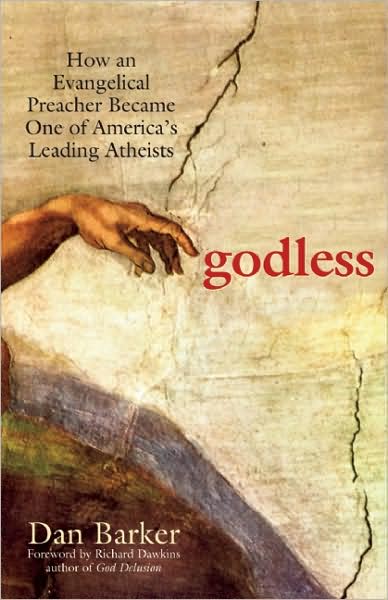
1. Godless (by Dan Barker)

Okay, first of all: great cover!  Second, what’s with that subtitle?  I think I should make a list of books that don’t fit the theme of their subtitle.  Barker spends the first chapter of his book detailing his life as a bible-thumping missionary/preacher/musician, then devotes chapter two (and only chapter two) to a brief synopsis of how he became an atheist.  In fact, it was so brief, I can’t even tell you exactly why he felt the need to examine his faith, or what, exactly, caused him to wake up from theism. 

In the remaining 18 (or so) chapters, Barker jumps from one godless topic to another: in one chapter, he tells of court cases his foundation (the Freedom From Religion Foundation) has battled to uphold separation of church and state.  In another chapter, he humorously points out the implausibility of an ominpotent and omniscient god.  These chapters are fun, informative reading, and they offer the theist LOTS to think about (and give free-thinkers plenty of responses!).  I just found it odd how disconnected the chapters were.  It’s especially weird considering the books begins as a biography – a genre that typically weaves its chapters together very tightly.

Bottom line: B

2. Why Don’t Penguins Feet Freeze? (compilation)

I purchased this book in a desperate attempt to find something to read before begininning the 4+ hour trip home from our vacation last week.  I’m not sure what to call this type of book (Q and A?  General knowledge?), but this kind of book is usually a safe bet with me.  I’ve read dozens of books like it, wherein a question is asked and then answered.  They’re fun to read, because they’re usually questions that only briefly pop into one’s mind during the day, but when you see the question in print, you think, ‘yeah, I have always wondered that’. Just listing off some of the book titles I’ve read will give you an idea of the kind of questions that are answered: How Does Aspirin Find a Headache?  Why Do Men Fall Fall Asleep After Sex? When Did Wild Poodles Roam the Earth? The cliche (regardless of author or publisher)  seems to be to name the book after one question found in the book.  I find this stupid, as it gives browsers the impression that there’s a whole book dedicated to (in this case) penguins’ feet.  The best books like this that I’ve read are David Feldman’s Imponderables series, Cecil Adam’s Straight Dope Series, and the book What’s the Difference?  This book, I have to say, is the worst of the bunch.  The thing that makes the other books great is the research that goes into them: industry and scholastic professionals are contacted, experiments are performed, and old history is dug up.  Not so this book – this book’s authors spent no time doing such pesky work.  They merely posted questions online, and selected the best (and often conflicting) responses for each question.  In fact, I can’t even tell you the answers to any question in the book, because any info I may have retained is suspect due to the fact that, no sooner did I read one answer, then I read the next answer which pointed out why the first one was wrong.  If you want to read stuff like this, just type your question into Yahoo and see what sort of responses you get from various, um, yahoos. 

(When I got back to Minnesota, I returned this book.  The ‘authors’ didn’t deserve my money.)

Bottom line: F

3. Disbelief 101 (S.C. Hitchcock)

Well, if you’re a friend of mine, chances are you won’t learn anything new from this book.  And that’s not an indictment of the book, no, it’s a comment on your age.  Disbelief is intelligently designed to appeal to the tween/early-teen crowd, and it does a superb job. 

The book is divided into several brief chapters that build on each other, explaining the absurdity of believing in god(s).  The book endeavors to shine light on the flaws of all religions but, as the author notes, ends up dwelling on the three ‘great’ monotheisms.  This only makes sense, as the book was prublished & is being marketed in the US. 

Hitchcock beautifully addresses concerns and fears a young person may have regarding casting aside faith. He even adivses youths on how to deal with their rational thinking should they happen to live in a household where dissenting opinions are forbidden.  This struck a chord with me – had I the audacity to pick up this book when I was, say, ten, the first three pages are probably would have had time to read before my Watchtower-sponsored guilt kicked in and told me to put the book back on the shelf.  But the author, knowing this sort of behavior is rampant amongst fundies, spends those three pages calming his readers & telling them it’s okay to set such ideas aside until free of well-intentioned care-givers who would likely not understand. 

Hitchcock makes the argument that, while phyiscal abuse is not tolerated in this country, mental abuse gets a free ride: punch your kid in the face, and the cops will come to your door.  Tell them that god will burn them forever in hell if they don’t accept Jesus into their heart, and everyone applauds your faith.  Good point. 

Oh, BTW, the best part of the book is the hilarious illustrations.

Bottom Line: A

4. The Invention of Hugo Cabret  (Brian Selznick)

Holy (insert expletive of choice)!  This was one phenomenal book!

I first spotted this book at Border’s a few weeks ago & thumbed through it.  I was surprised to see such a thick book (it’s over 500 pages) in the children’s section.  It looked intriguing, but I didn’t have the cash to buy it.  Fast forward to the mad-dash while on vacation (see above) and I contemplated buying it again.  Alas, I didn’t want to bring such a big book in an already crowded car.  So I finally picked it up from the library on Friday, and I had finished reading it by Saturday afternoon.

Did I mention this is an awesome book? The story unfolds partly in text / partly in pencil drawings.  It begins, like a film, by drawing back the curtain on Paris, circa 1930, and tracking across the city, finally zooming in on a young orphan who lives behind the walls of the train station.  He fends for himself while hiding a couple of big secrets.  His spars with a local vendor he steals from (sorry for the spoiler, but, come on, it can’t be that revealing to learn that a homeless orphan has to steal food), befriends a young girl, and, well, I can’t really say anymore than that without ruining anything.  As the story progesses, the threads of Hugo’s life begin to come together, and the ending – full of surprises – is poingiant, satisfying, and just plain beautiful.  The book ends with an appendix (how many juvenile novels end with an appendix?)…which I actually read.  Yeah, that’s right, the book was so good, I read the appendix.  And it, in turn, offered several websites that I visited to find out more.

If you read this book, don’t do what I did (I flipped through the book before reading it, and, since much of the story is told in pictures, I had an inkling of what was going to unfold); just open to the first page, and begin reading. 

Suspense!  Pathos!  Beauty!  Humor!  I can find no defect in this work of art.

Bottom line: A

I Still Hate Minneapolis

So, despite numerous difficulties in the past, I once again decided to venture into downtown Minneapolis yesterday.  Specifically, I volunteered to help at a booth for the Minneapolis Planetarium’s Solstice celebration.  Since there is no Minneapolis planetarium (yet), the event was held at the Minneapolis Central library.

I was scheduled to be there from 4 – 8:00.  My wife and son were interested in checking out the event, too, so they followed behind me in a separate car so that they could leave at any time. 

Before leaving, I entered the Library’s address into Mapquest.  Mapquest only ever fails me on two occassions: 1) when attempt to locate new roads/neighborhoods and 2) when downtown Minneapolis is involved.

We began by heading west into that most god-forsaken of cities.  After about 5 miles on the interstate, I saw a sign alerting me to the Cedar Avenue exit (so far so good).  The directions, which I obtained from Mapquest, and the accompanying map, called for me to exit Cedar, go about 5 blocks, then use the left-side exit to get onto MN-155.  I’ve never heard of this road before, but, oh well…

I drove down Cedar for four blocks, then spotted the left-side exit.  But it wasn’t for 155; it was for 35W.  Maybe this was one of thousands of cases wherein a single stretch of road has two names. But, either way, the exit was clearly for 35W and only 35W – there was no signage for 155.  I suppose I could’ve taken the exit, but when you know you’re within a mile of your destination, the last thing you want to do is get on a freeway with limited access to the local roads; I was afraid it would dump me off two miles away and then I’d really be stuck. 

Instead, I swerved back onto Cedar, and made a left one block later.  This put me on Washington Avenue and, I assume, one block north of where I really wanted to be.  No problem, thought I, I would just drive down until I got to Nicollet Mall (that’s the street the library is supposedly on).  When I got to Nicollet, guess what?  No cars are permitted on that road (for as asinine as people claim St. Paul’s roads are, let me just say: YOU CAN DRIVE ON ALL OF THEM!). Still, I didn’t panic. I just went down to the next block…which was a one-way street upon which I couldn’t make a left.  So I went down one more block.  I began heading southwest on this road, hoping to find 3rd Avenue South (that was the cross street I was looking for). Unfortunately, the crossroads were increasing in number and were all designated as North roads – even though I was going south. 

Eventually, I decided to make a left, and then another left, so that I was heading north.  This time, I found 3rd Avenue.  But, of course, I couldn’t turn on it (another one way).  So I went around the block, even driving on a closed road for lack of what else to do.  Finally, I was driving on 3rd Avenue, heading towards Nicollet Mall.  When I got to (what I assume was) the correct block, guess what? No signs telling me which building was thr correct one.

This is a lesson both downtowns should heed: Put a freakin’ sign on your building.  With the very rare exception of famous icons (such as the Metrodome and the State Capitol, for example), every building should have a name that says what it is.  Like last year, we were invited to a party at the Depot in Minneapolis.  Which, stupidly, has a big sign on it that says “Milwaukee”.  If you ever hold a party at the Depot, make sure you tell your friends it’s at Milwaukee.  I know, I know, it doesn’t make any sense.

Anyway…I was quite likely driving right in front of the library…not sure.  But what difference did it make? I still had to park.  The email from the Planetarium people said there was an undergroung garage I could park in for $5.  But I couldn’t find it.  Not the first time, nor the second time I looped around the block (and since there’s a stoplight ever 10 feet in Minnecrapolis, looping around the block takes about 5 minutes). Oh, I did see one underground ramp, but it was labeled “Marquette Plaza Parking Only”, and I wasn’t sure if the library was in the Marquette Plaza (maybe they should put up a sign?).  Also, it showed a price of $8…not the $5 I’d been promised. 

I started to go around the block a third time, then decided to stop at a cafe to ask directions.  Here’s what the lady behind the counter told me:

“Go 2 blocks down to Hennepin, then make a right.  The library will be three blocks down on your left.”

…Of course, that still didn’t solve my problem of where to park my 2 cars, but I figured I’d run into the library & ask someone to physically point to the parking ramp.

So, I drove the two block and then, magically, found Hennepin!  But guess what? No right turns allowed. So I drove another block, and there was that stupid anti-car street again, mocking me with it’s smooth asphalt and hope of a destination.  So I drove another block and, guess what? No right turns allowed. So I drove another block, and that was the under-construction street that was closed.  I didn’t want to risk driving on it again. So I drove another block and, guess what? No right turn.

So I cut my loses and went home. My wife got lost on the way home, my son was disappointed, and I failed to fulfill my volunteer duties.  An hour and a half of driving two cars around on a 90 degree day.  Did I mention my car doesn’t have A/C?

People often like to make fun of St. Paul’s streets, saying there’s no rhyme or reason to the street names.  I admit, it is comforting, if you can’t find 38th street, to suddenly chance upon 39th street and know that you must be close. But I don’t mind the ‘neighborhood’ portions of Minneapolis…it’s the downtown that frustrates me.  Consider this: St. Paul, like Minneapolis, has numerical streets in it’s downtown, too.  In St. Paul, there is never more than one consecutive one-way street.  You can drive on all the streets.  And it’s only 2/3 the size of Minneapolis, so it’s easier to navigate simply by virtue of being smaller.

I’ve said this before, but this time I’m saying it online: If I’m invited to something in downtown Minneapolis, I’m not going.  It’s not worth it.  I’d rather stay home than drive around that mess for an hour only to drive back home anyways.  If you really want me to go, you can pick me up. Or, like my brother-in-law did a few months back, you can skillfully plan for us to commute together via mass transit.

Drink Pepsi!

While hosting a cable show last week, I asked the following question:

It seems that the only arguments against gay marriage are on religious grounds.  Is that fair to say?

One of my interviewees, an atheist with a doctorate in theology, readily agreed.  The other interviewee, an employee of Christian organization with a seminary degree, said something like this: “That’s a great question; a lot of people make that assumption.  However, there are other reasons for not legalizing same-sex marriage: some have argued that it’s simply not natural; animals do not engage in homosexuality.”

I was going to move on to the next topic for discussion, but the atheist intervened and politely pointed out that there is homosexual behavior in animals.  He even pointed out my all-time favorite study in this area – a study that appeared in a 2003 issue of Endocrinology finding that 8% of domestic rams prefer other rams over ewes.  (Give a whole new meaning to the term “sheep-like”, doesn’t it?)  And, though I did not mention this during the show, I have owned more than one pair of lesbian birds.

But my point here is not whether or not same-sex marriage should be legalized; my point is this: It is my finding that people will attempt to prop up tenuous beliefs with secular supporting arguments.  In this way, it helps to validate a position which lacks inherent ‘truthfulness’ or even logic and, perhaps, win over non-believers.

Apart from the above, a case in point is an issue my former religion took with blood transfusions.  Of course, their main argument for shunning blood was their interpretation of a verse in Acts. But they often cited the risk of HIV from tainted blood.  In this way, the HIV-risk served as a validation for their unique (and occasionally fatal) stance on blood.

A better example is birthdays.  Last night, I had another enjoyable phone conversation with a relative who, among other things, told me that if, indeed, I had done all the research I claim to have done, then I should know birthdays are wrong – “You know candles on cakes are of pagan origin, and no Christians in the first-century celebrated their birthday and if it was so important to celebrate birthdays, why doesn’t the bible say when Jesus was born?”

In the fluster of the exchange, I tried to quickly dispel these ‘supports’ for what is quite possibly the Witnesses’ most arbitrary policy.  I pointed out that no one is claiming that birthday celebrations are “important”, and that, if we are to use the first century Christians as examples, where is the record of them reporting their time, attending five meetings a week, shaving, celebrating graduations, wedding anniversaries, and baby showers (a birthday party if there ever was one!)?  These are all practiced by Witnesses today…though each item lacks a first-century precedent.  On the matter of candles, I noted that my wife and I had been the frequent recipient of candle-topped cakes for our wedding anniversaries, and that these cakes were often the gift of Witness family members.

This caused my relative to become quite agitated.  The subject was abruptly changed: “That’s not why I called,” was the scathing bit of logic that brought an end to that discussion.

Anyway… what I’m trying to say is that those ‘supporting rationales’ lend credence to a policy/belief/desire that has no fundamentally sound premise.  For example, I might say: “Yummy, I like to drink this Pepsi.  And you know what; it’s also good for me!”  Then someone might respond: “Um, actually, it’s not good for you.”  I could either abandon my soft drink consumption, or confess the reality: “Yeah, I know.  The thing is, I just love the taste.  Is that so bad?”

No, in the case of Pepsi drinking (and I do not drink Pepsi), perhaps it’s not so bad.  But when it comes to forcing a wedge between family members, or denying sheep-like people their civil rights, then I want some valid rationales.

So I ask: What are the (valid) reasons for not legalizing gay marriage? 

Loving Religion Strikes Again!

I received a phone call from my mother on Thursday (thoughtfully calling on my son’s birthday) in which she re-invited me to her wedding. Now I have to make a decision as to if I will attend or not.
If that first paragraph sounds crazy to you, it’s because religion is involved. Let me explain: In late February, after dating a man for a month, my mom announced she was engaged. Two weeks later, she invited us to her house where, for the first time, I met my future step-father. She spoke of her desire for a small wedding, in her fiancé’s backyard, with only a dozen or so family members in attendance. She was excited to have me, my wife, and son there, and told us to set the date aside. She even asked my wife to be the photographer.
So far so good…
A week later, however, she called, nearly in tears, informing me that I was now un-invited. The reason was because a couple of elders from her congregation (she’s a Jehovah’s Witness) corralled her fiancé into a meeting and told him that I was a disassociated ex-Witness and thus my presence at the wedding would be offensive to the Witnesses in the audience.
Incidentally, I am flabbergasted (God, I love that word) that elders from the congregation have a say in who my mom’s invites over to her house. It’s kind of like if my boss called me into his office and sternly charged me not to have any ex-employees over for dinner.
First my mom was shocked and appalled that I was disassociated. When I told her I had not disassociated myself, she said: “But they said that you sent a letter to the elders.” “Yes,” I explained, “I did send them a letter, but it was in response to their desire to meet with me. I told them I would meet with them, but they never responded.” My mom insisted that I must have disassociated myself, but when I offered to read the letter, she refused to listen. I tried pointing out to her that the Witnesses at her wedding would have nothing to worry about – I had no desire to expose their religion at my mom’s wedding – and, if anything, I should be afraid of them, as they are the ones who pride themselves in aggressive proselytizing. “But they’re good people,” she argued, implying that I was not.
After hanging up on me, my mom called a few days later admitting that perhaps I was being honest when I said I’d never disassociated myself but that, regardless, a person can be considered disassociated by their actions. This is complete bullshit. I mean, yes, the Watchtower Society does teach that if a former member disagrees with the current official doctrine on any point, than that person is defaulted as disassociated, but the bullshit stems from the fact that my sister and wife were both still invited. I’m not gonna expose their lives here, but, needless to say, both of them have done many many many many things contrary to Witness doctrine. Indeed, when my mom mentioned the existence of my website as sufficient reason to expel me from her wedding, I pointed out that it was my wife who loaded all the information onto the web. My mom did not know how to respond to this, and attempted to discuss the possibility of my uncle and aunt being allowed to pick my son up on the day of her marriage so that he may attend her wedding. “But you probably wouldn’t allow that,” she said in an accusatory manner. “Mom,” I asked, “when I was a little boy, would you have wanted me to go somewhere that you were not allowed to go to, especially if you knew all the people in attendance hated you and Dad?” After expressing her continued sorrow that I was hurt (“I didn’t think you’d be hurt by this,” she cried, “I thought you’d be happy for me”), we ended our conversation.
I called my sister and told her the whole tale. My sister decided that if I was prohibited from attending, then she would not go either, preferring instead the solidarity of our position. She was relieved, too, as she’s had a long history of not enjoying the company of Witnesses. She also works as a hair stylist and had only, with great finagling, gotten the day off. She said she’d now go to work on that day.
Then on Thursday came the aforementioned phone call. I laughed when my mom explained that an elder stopped by her house and decreed that, since she is now getting married at a community center, the elders can not stop me from attending. When my mom said “Please don’t laugh at me,” I felt bad for acting so flippant (I still do), but I had to point out the absurdity: why does switching the event from her home to a community center make a difference? “Well,” she said, “the community is a public place; they can’t stop people from attending, just like they can’t stop people from attending the Kingdom Hall.” (This statement is erroneous as well, but that’s another story.)
“But they can tell you who you can have at your own home?” I asked.
The conversation devolved from there. My mom started crying when she said how scared she was that I was against Jehovah, and when she asked if I was happier now than I was as a Witness, she became upset when I said that I was. (Man, only a religion can play with people’s heads like that.) After implying that I lacked both rules and a conscience, my mom attempted to counter my happiness by pointing out all the trials she’s had in the religion and, when I said “Yeah, see, right there – you just pointed out three reasons why the religion causes unhappiness,” she got frustrated that her ‘encouragement’ had back-fired.
When I asked her if the people in attendance would act like Christians or shun me, she refused to answer, instead saying: “Well don’t worry about them, right? Just care about me – your mother. It would mean a lot to me.” This struck me as highly hypocritical, as only weeks earlier she had kowtowed to the (supposed) desires of her guests by un-inviting me (a violating of Matthew 5:37, but that, too, is another story). But instead of pointing this out, I asked her: “Are you coming to Owen’s birthday party on Sunday?”
“Oh, honey, you know I can’t do that,” she said, and she went on to complain of the materialism and cake-eating that take place at such parties.
“Well,” I said, “don’t worry about all that, right? Just care about Owen – your grandson. It would mean a lot to him.”
There was silence, and then my mom repeated that she could not attend.
Her arguments against Owen’s birthday party, incidentally, are completely spurious. True, there would be cake…but there will also be cake at my mom’s wedding.  In the matter of gift giving, we indicated on Owen’s invitations that no gift was necessary.  Besides, my mom is undoubtedly Owen’s primary gift-giver. Indeed, she has given Owen so many gifts through the years that we have (more than once), requested she curtail this behavior.  Why is materialism acceptable on the 364 days a year that are not Owen’s birthday?  Additionally, I would bet good money (betting is also a sin) that my mom will receive more gifts on the day of her wedding than Owen received at his birthday party.
Anyway…
Do I go to her wedding? I’m not sure. She lacked the decency to show up at her grandson’s birthday party. Additionally, my sister, who decided to stand by me, now has to work on Saturday…so it seems kind of odd that I would now go without her. I had originally wanted to go to the wedding when my wife and I were guests that my mom desired to have in her company; now we are persona non grata that some elder is allowing to attend. My mom also made it clear that we would be expected to leave after the ceremony, lest our presence sully the cake-eating and gift-giving.
We recently attended another wedding and reception. The wedding was upstairs in a church, and the reception was downstairs. Owen had a good time. Last weekend, I asked him: “Would you like to go to another wedding?” He said: “Only the downstairs part.” So, if we do go, how do I explain to a four year old that one of his best friends – who refused attendance at his birthday party – demands that he leave prior to the “downstairs part”? I don’t know.
Whether or not I go, I will long view this as the strongest evidence yet that the Witnesses, apart from being theologically and scientifically wrong, are just plain unloving. Or rather, in the case of my mom, they are loving people who are forced to perform unloving acts in the name of their precious book publishing company.