Category Archives: Current Events

How I Improved Target

A few weeks ago, Jennifer and I herded the whole family out the door for a fun-filled trip to Menard’s and Target. As we were leaving, I pulled out the stack of coupons we had sitting in a bin by the door. I asked my wife if we needed to bring any of them, and she said we didn’t need the shampoo coupon because she had just bought that shampoo at Target last week.

“Oh, and you didn’t use the coupon!” I said. She admitted she forgot. No problem. I grabbed the receipt from the week before and brought that, and the $2-off coupon, with us on our trip to Target.

When we got there, I walked over to the returns counter. The women working there pressed some buttons on her register. Then the drawer popped open and she handed me two dollars. That’s it. Just two dollars. Exactly. This was especially baffling since usually the employees just zap the code on the coupon and then on the receipt and the computer tells them how much to give back. If I had returned the bottle of shampoo, I wonder if she would have just given me back the $10 base cost instead of the $10.73 that the receipt showed.

So I said, “What about the tax?”

She said, “Huh?”

I said, “I paid tax on this two dollars, so I need that returned to me, too.”

She said, “No, sir, the coupon is only for two dollars off.”

I said, “Yeah, but look here at the receipt. I paid tax on the shampoo, and since I didn’t have to pay as much for the shampoo now, I don’t have to pay as much tax on it, either.”

She said, “Um…but the coupon only says for two dollars off.” She picked up the coupon and showed me.

So I said, “Whatever.”

Yep. That’s it. I just walked away. I mean, I know I could have stood there and complained, but after our brief exchange yielded no indication that the employee understood basic math, I remembered something from a book I recently read at work about the voice-of-customer: It’s better to complain to the customer service department. I mean, yes, the returns counter at Target is generally touted as the customer service department, but it’s just the first level. And, if it’s staffed by people who think I owe them tax on two dollars I didn’t pay…then my energy is best spent elsewhere.

So, that evening, I sent a brief email to Target. My main purpose wasn’t to demand my fifteen cents (though I did say it was still owed to me), but to tell them they need to train their employees on the nuances of refunds.

Last week, I received a response from Target Guest Relations. The letter read, in part:

We’ve taken these comments very seriously, so thanks for taking the time to let us know about not receiving your tax refund when you cashed in your coupon. Enclosed please find a $3 apology coupon. Thanks for writing. Your feedback helps us improve our service commitment to you.

So there you have it: Complain at the front desk, and I might – might! – have gotten my fifteen cents back. Write to the guest relations department, on the other hand, and I got twenty times the amount I was owed.

Oh, and I just made Target a slightly better place to shop. So, there. You’re welcome.

Number Eight

Last summer, I wrote about finding a file on an old hard drive where I listed stuff I want to do and things I’d like to do. The eighth item on the list (excluding items I crossed out) was “Have a letter published in a magazine or newspaper.” And here’s what I said about it in that blog post:

I sent a letter to The Monticello Times, and a reporter called back and asked to interview me. Plus, I’ve had entire articles published in newsletters, magazines, and books, so even though I don’t think I’ve accomplished this task per se, I’ve kind of trumped it.

Well, now I have accomplished it. When I was paging through the February 20th issue of The Villager, I happened upon this letter…

I wrote a response letter a few days later. It didn’t appear in the next issue (06 March), so I figured they just weren’t going to publish my letter. That’s okay…it’s happened before. In fact, about four years ago, I wrote a letter to the Pioneer Press and one of their staff members even called me a few days later asking about shortening my letter in a certain spot, and I said that was fine. Alas, they didn’t publish it.

But then the March 20th issue arrived on our doorstep (in fact, three copies arrived…not sure if that was just a weird paperboy mistake, or if it was intentional). And, when I got to page 11, here’s what I found…

Continued on the next column…

Thank You, AMC Showplace

I gotta thank the local megaplex, AMC Showplace in Inver Grove Heights, for reminding me why I hate going to the movie theater. Don’t get me wrong, the movie itself was just fine (I saw Oz the Great and Powerful with my wife, son, brother-in-law and niece). Despite AMC’s attempts to wreck the experience.

We bought a beverage at the concessions stand. I think we got a Sprite. That’s all there is: cola and slushies. So, if you’re looking for something to drink that doesn’t taste shitty, I guess you’ll need to sneak in your own drink. I would have, but my pockets were already full. The Sprite was five dollars, which is a complete ripoff. Not even the “Great” Minnesota Get Together can top that.

So then we walk into the theater room. Now, when I walked into a movie theater as a kid, the screen would just be showing some prototypical screensaver, like a close-up on a lava lamp or moving bars of color. At some point in my teens, megaplexes changed to showing slide-shows of advertisements. That wasn’t as cool as the trippy screensavers, but I understood the theater was probably making some money off selling the space to advertisers, so no harm done, I suppose.

But this past Saturday, when I walked in, I was assaulted with LOUD commercials. So loud it was hard to talk to each other. As someone who mutes the TV at home when a commercial is on, changes the channel on the radio in the car when a commerical is on, and skips past all the bullshit on DVDs, this was truly assaulting to me. I would have covered my ears, except that I’ve kind of figured out that if someone in their 30s does this, people think you’re mentally challenged.

So after ten minutes of this full-on audio bombardment, the lights dim slightly and I am tortured with a video recapping the commercials I just watched. The voice-over said things like, “You were wowed by Justin Bieber’s concert ad, and fell in love with Coke all over again.” Do I even need to comment on how obnoxious that was? If my Sprite hadn’t cost its weight in gold, I might have just launched it at the screen at that point.

Then a commercial for the theater begins. This is akin to a restaurant forcing you watch a commercial about that restaurant before you can eat your meal. It was redundant, too, since the pre-showtime commercials contained an AMC commercial, as well.

So then the previews, right? Wrong. First there were two or three commercials about shit that had nothing to do with movies. Then, finally, a preview. Okay, I’m read-up enough on the world of cinema to know what’s coming down the theatrical pipeline without having to sit through trailers, but I’m willing to give them a pass. At least they’re relevant to my interest (I did come to see a movie, after all), and sometimes, they’re entertaining.

Usually, though, the trailers match the feature presentation, right? I mean, last summer, when Jennifer and I took the kids to see Brave, the trailers were all for animated – or at least kid-friendly – films. In fact, I would go so far as to say that the trailers are good predictors of the feature film you’re about to watch. That is, if the trailers are interesting, or enjoyable, then so will be the movie that’s starting in a few minutes.

But AMC apparently doesn’t subscribe to this policy. There were at least six previews, and three of them dealt with a post-apocalyptic Earth and looking insanely boring. One starred Tom Cruise, so that’s a must-miss right there. There was also a preview for a cinematic adaptation of The Great Gatsby, which looked just as bloated and lousy as the shitty novel I had to pretend to read back in 11th grade. (Disclaimer: I did read about 75% of it, but gave up when I realized I had better things to do with my time. Like stare out the classroom window.)

Okay, then another commercial for AMC. And then…are you ready for this? Another commercial for AMC. These are completely counterproductive, of course, because every minute they delay the film to talk about this very theater just increases the likelihood that I’ll never want to return.

Finally, at 1:36, our 1:15 showing began. This absurd delay made my son anxious (“When is it starting?”) and ensured we were late in returning to our babysitter, who was getting paid by the hour to watch Isla.

I suppose my only other option is to watch a movie for about $1.00 (via Netflix or Redbox), whip up a batch of non-soggy popcorn, pour myself some real tea or craft beer, sit in a comfortable couch, skip past the ads, and watch the movie in the comfort of my own house. I guess I’ll try to make due.

How About a Little Love for Northup?

In class last week and this, we are reading Twelve Years a Slave. It’s part of the slave narrative genre that was so popular back in the waning days of slavery (all the cool abolitionists were reading them). Unlike other slave narratives of the time (I’m thinking of Frederick Douglass’ memoir and Uncle Tom’s Cabin), though, no one much reads this book by Solomon Northup anymore. Admittedly, I hadn’t even heard of it until the first day of class when I saw it on the syllabus and then went and bought my very own copy.

This is the third book we’ve read so far this semester and it’s my favorite so far. Unlike Douglass’ book (which is awesome), Northup’s tale begins with his freedom. That’s right, he was born and raised a free man in New York. But one day, he was drugged and captured and spent a certain number of years (I won’t say how many, because I don’t want to spoil it for you) in indentured servitude, longing for the day when he’d be reunited with  his wife and three children. In a way, then, Douglass’ book takes us on a long rise from despair to hope, while Northup’s follows a curve down to despair, and then back up. Douglass’ book is better written; Northup’s first chapter, in particular, is a boring list of facts and he frequently ruins any chance at surprise and foreshadowing the plot would otherwise have. He also revels in regaling us with details into the life of pretty much everyone he ever passes on the street, for Christ’s sake. Still, it’s a great story that needed to be told, it has a killer subtitle (Narrative of Solomon Northup, a citizen of New-York, kidnapped in Washington city in 1841, and rescued in 1853, from a cotton plantation near the Red River in Louisiana – beat that, Douglass!), and I am eagerly anticipating the movie (Brad Pitt, presumably, will not be playing the role of Northrup).

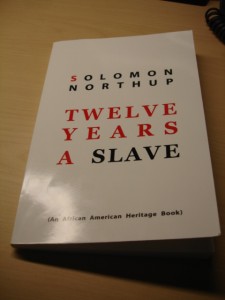
Anyway, I think the best way to demonstrate just how forgotten this work is, is to show you pictures of the piss-poor manner in which this book is published.

Okay, here’s the cover. Borrrring!

I keep trying to figure out the significance of the colors – black on white? With red? A red S? Does any of this mean anything? Nope. Notice the publisher put their name in parenthesis – yeah, I would too if I published books that looked this boring (and if my books had spelling and punctuation mistakes on every page, which this one has aplenty).  What’s even funnier is that the title page lists a credit for the cover photo. Don’t you see the photo? It must be a photo of a glass of milk on a paper plate in a snowstorm.

Here’s the back cover. I know you probably can’t read it, but it’s mostly one big paragraph that the publisher spent about three minutes writing. The publisher tries to drum up excitement for this book by asserting that you should read this book because – get this: other people have read the book, and they are able to recall the fact that they’ve read it! Don’t believe me? Here’s what it says:

“Scholars reference this work today’ one example is Jesse Holland, who referred to him in an interview given on January20, 2009 on Democracy.now. He did so because Northrup’s extremely detailed description of Washington in 1841 helps the neuromancers understand the location of some slave markets, and is an important part of understanding that African slaves built many of the monuments in Washington, including the Capitol and part of the original Executive Mansion.”

Yeah, if that’s not the crappiest endorsement for a book I’ve ever read, I don’t know what is. Is “neuromancer” really the best word they could use? Oh – and it’s in all-caps for ya’, too, so that helps.

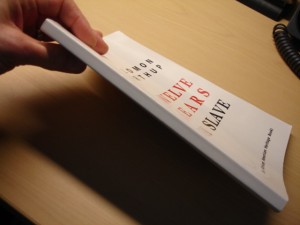
And just to make sure no part of Northup’s amazing story gets the disrespect this publisher feels it deserves, here’s the spine:

Wait…what does that say? Does it say nothing at all? That will really be helpful when I place this on my bookshelf and then have absolutely  no way of knowing which book it is. Is it entirely white? Huh. Maybe there is some symbolism there.

Oscar Opinions

Well, for the first time in memory, I watched the Acedemy Awards ceremony last night without having first seen any of the Best Picture nominees. In fact, the only nominated films in any category that I saw were Brave and The Avengers.

Actually, I didn’t even watch the whole program. We turned it on late, thereby missing the opening monologue, which is generally the most entertaining part. I also went to bed early, and didn’t know who or what won for actor, actress, director, and picture until this morning.

The bottom line is that I really have nothing to say about Argo winning for Best Picture. I hear it was a slight upset, as Lincoln was favored and Life of Pi, by virtue of its numerous nominations, was second-favored. Ask me in a few months, after all these flicks have been made available on DVD, and I’ll be happy to offer an opinion. In fact, I’ll probably offer my opinion here, on this blog, even if you don’t ask.

But in keeping with the spirit of the Oscars, I present this list. Below you will find a list of all the Best Picture winners since 1990. In the third column, I offer my (very brief) opinion. The one-word opinions breakdown thusly:

Bravo!: The Academy nailed it, as far as I can see. In other words, I’m in complete agreement with that year’s win.

Fine: There were better options, which I list in column four, but the film that won was a good choice, and I can’t really gripe about it.

Meh: This film wasn’t my thing. There were better options, which I list in column four, but I can still see why they picked this one. I can respect their choice, even if I disagree.

Yuck: I am baffled that this crap was even nominated, and utterly shocked that it won. What were they thinking? Is it too late to do this year over again? I list two superior choices in column four, though I could easily list another five or six preferable films from that year.

[table "16" not found /]