
Category Archives: Books, Film, and TV

Recent Reads

In a bold-face plagerism of my wife’s idea, I here offer my thoughts on the latest books I’ve read…
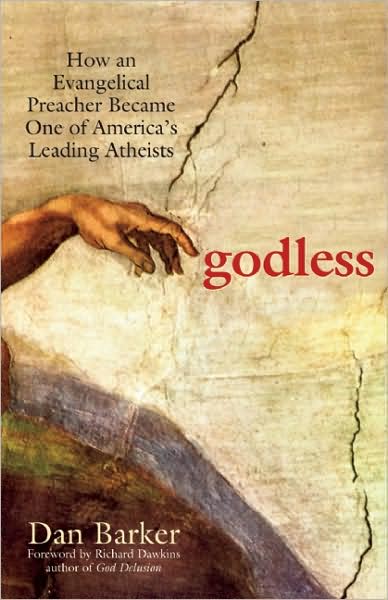
1. Godless (by Dan Barker)

Okay, first of all: great cover!  Second, what’s with that subtitle?  I think I should make a list of books that don’t fit the theme of their subtitle.  Barker spends the first chapter of his book detailing his life as a bible-thumping missionary/preacher/musician, then devotes chapter two (and only chapter two) to a brief synopsis of how he became an atheist.  In fact, it was so brief, I can’t even tell you exactly why he felt the need to examine his faith, or what, exactly, caused him to wake up from theism. 

In the remaining 18 (or so) chapters, Barker jumps from one godless topic to another: in one chapter, he tells of court cases his foundation (the Freedom From Religion Foundation) has battled to uphold separation of church and state.  In another chapter, he humorously points out the implausibility of an ominpotent and omniscient god.  These chapters are fun, informative reading, and they offer the theist LOTS to think about (and give free-thinkers plenty of responses!).  I just found it odd how disconnected the chapters were.  It’s especially weird considering the books begins as a biography – a genre that typically weaves its chapters together very tightly.

Bottom line: B

2. Why Don’t Penguins Feet Freeze? (compilation)

I purchased this book in a desperate attempt to find something to read before begininning the 4+ hour trip home from our vacation last week.  I’m not sure what to call this type of book (Q and A?  General knowledge?), but this kind of book is usually a safe bet with me.  I’ve read dozens of books like it, wherein a question is asked and then answered.  They’re fun to read, because they’re usually questions that only briefly pop into one’s mind during the day, but when you see the question in print, you think, ‘yeah, I have always wondered that’. Just listing off some of the book titles I’ve read will give you an idea of the kind of questions that are answered: How Does Aspirin Find a Headache?  Why Do Men Fall Fall Asleep After Sex? When Did Wild Poodles Roam the Earth? The cliche (regardless of author or publisher)  seems to be to name the book after one question found in the book.  I find this stupid, as it gives browsers the impression that there’s a whole book dedicated to (in this case) penguins’ feet.  The best books like this that I’ve read are David Feldman’s Imponderables series, Cecil Adam’s Straight Dope Series, and the book What’s the Difference?  This book, I have to say, is the worst of the bunch.  The thing that makes the other books great is the research that goes into them: industry and scholastic professionals are contacted, experiments are performed, and old history is dug up.  Not so this book – this book’s authors spent no time doing such pesky work.  They merely posted questions online, and selected the best (and often conflicting) responses for each question.  In fact, I can’t even tell you the answers to any question in the book, because any info I may have retained is suspect due to the fact that, no sooner did I read one answer, then I read the next answer which pointed out why the first one was wrong.  If you want to read stuff like this, just type your question into Yahoo and see what sort of responses you get from various, um, yahoos. 

(When I got back to Minnesota, I returned this book.  The ‘authors’ didn’t deserve my money.)

Bottom line: F
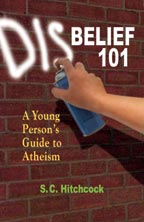
3. Disbelief 101 (S.C. Hitchcock)

Well, if you’re a friend of mine, chances are you won’t learn anything new from this book.  And that’s not an indictment of the book, no, it’s a comment on your age.  Disbelief is intelligently designed to appeal to the tween/early-teen crowd, and it does a superb job. 

The book is divided into several brief chapters that build on each other, explaining the absurdity of believing in god(s).  The book endeavors to shine light on the flaws of all religions but, as the author notes, ends up dwelling on the three ‘great’ monotheisms.  This only makes sense, as the book was prublished & is being marketed in the US. 

Hitchcock beautifully addresses concerns and fears a young person may have regarding casting aside faith. He even adivses youths on how to deal with their rational thinking should they happen to live in a household where dissenting opinions are forbidden.  This struck a chord with me – had I the audacity to pick up this book when I was, say, ten, the first three pages are probably would have had time to read before my Watchtower-sponsored guilt kicked in and told me to put the book back on the shelf.  But the author, knowing this sort of behavior is rampant amongst fundies, spends those three pages calming his readers & telling them it’s okay to set such ideas aside until free of well-intentioned care-givers who would likely not understand. 

Hitchcock makes the argument that, while phyiscal abuse is not tolerated in this country, mental abuse gets a free ride: punch your kid in the face, and the cops will come to your door.  Tell them that god will burn them forever in hell if they don’t accept Jesus into their heart, and everyone applauds your faith.  Good point. 

Oh, BTW, the best part of the book is the hilarious illustrations.

Bottom Line: A

4. The Invention of Hugo Cabret  (Brian Selznick)

Holy (insert expletive of choice)!  This was one phenomenal book!

I first spotted this book at Border’s a few weeks ago & thumbed through it.  I was surprised to see such a thick book (it’s over 500 pages) in the children’s section.  It looked intriguing, but I didn’t have the cash to buy it.  Fast forward to the mad-dash while on vacation (see above) and I contemplated buying it again.  Alas, I didn’t want to bring such a big book in an already crowded car.  So I finally picked it up from the library on Friday, and I had finished reading it by Saturday afternoon.

Did I mention this is an awesome book? The story unfolds partly in text / partly in pencil drawings.  It begins, like a film, by drawing back the curtain on Paris, circa 1930, and tracking across the city, finally zooming in on a young orphan who lives behind the walls of the train station.  He fends for himself while hiding a couple of big secrets.  His spars with a local vendor he steals from (sorry for the spoiler, but, come on, it can’t be that revealing to learn that a homeless orphan has to steal food), befriends a young girl, and, well, I can’t really say anymore than that without ruining anything.  As the story progesses, the threads of Hugo’s life begin to come together, and the ending – full of surprises – is poingiant, satisfying, and just plain beautiful.  The book ends with an appendix (how many juvenile novels end with an appendix?)…which I actually read.  Yeah, that’s right, the book was so good, I read the appendix.  And it, in turn, offered several websites that I visited to find out more.

If you read this book, don’t do what I did (I flipped through the book before reading it, and, since much of the story is told in pictures, I had an inkling of what was going to unfold); just open to the first page, and begin reading. 

Suspense!  Pathos!  Beauty!  Humor!  I can find no defect in this work of art.

Bottom line: A

My Favorite Planet

Disney attempts to recapture the success of their 1950s series True-life Adventures (their collection of multi-Oscar winning nature documentaries) with the release of Earth. Earth is the first in a line of proposed projects under the Magic Kingdom’s Disneynature independent film label, created in 2008.
Striving to present events in chronological order over the course of a single calendar year, Earth has been billed as “following the migration paths of three animal families.” But that’s only part of the story, as the three families (polar bears, elephants, humpback whales) combined account for only about half the screen time. Interspersed throughout, Earth shows the mating rituals of New Guinean birds-of-paradise, the predator-prey relationship of wolves and caribou, the demanding search for water across the African continent and, in a humorous segment, a family of ducklings’ first “flight” out of the nest.
Being Disney, the film-makers use every trick of the trade. With footage largely culled from the BBC program Planet Earth, we are treated to expansive aerial scenes of migrating throngs of animals, slowed down footage of great white sharks breaching out of the water to capture their meals (a taste of nature so captivating it deserves—and gets—repeated showings), time-lapse segments of a forest floor greening and flowers opening up their enticements to their unsuspecting pollinators. Filming took place in 64 countries, including Nepal, where the producers were given access to spy planes enabling them to record the first ever footage of aerial shots over Mt. Everest. The documentary covers the planet from north to south—it begins on the Arctic ice and ends on the shores of Antarctica. In between we are shown forests, waterfalls, oceans, jungles, mountains, and deserts and there is scarcely a moment when the screen does not amaze—from the small close-ups of a duckling scrambling to its feet to the low-earth orbit shots of the sun rising over the orb of the planet. All told, at $40 million, this is the most expensive documentary ever created.
James Earl Jones provides narration, and besides fawning over the beauty and light-heartedly commenting on the funnier moments, he offers several truly fascinating bits of information. While we watch the uneasy alliance between elephants and lions at a small, lone watering hole, Jones notes that the elephants, with their superior size, dominate by day, but the lions, with their legendary feline vision, dominate the night. He also points out that half of the world’s oxygen is produced, not in the rain forests, but in the coniferous tree line where arctic meets temperate.
The narrator takes the opportunity to comment on environmental issues; not surprising as this film was released on Earth Day, and its subject matter lends it to such discussions. The warnings and respect the film’s creators dispense, however, are subtle: the main message here is the planet’s beauty, after all, and the dialogue is careful to not turn off those who do not consider themselves green. They are successful in this regard; it’s much easier to win people over to caring for the earth when showing them footage of the precious and spectacular planet, rather than forcing them to listen to a politician.
Earth is appropriate for children, though some might be scared by scenes of animals capturing their prey. In true Disney fashion, the scene cuts before anything brutal happens, but there are brief shots of carnivores tagging their prey with the paws and clamping down on the necks of their victims. If you do go, and your little ones haven’t gotten too antsy by the end, stay for the credits: a split-screen shows the audience how some of the unique and difficult scenes were captured on film (perhaps this is Disney attempting to preemptively answer the charges of staged shots that marred the True-life films). Both informative and humorous, these brief glimpses at the cinematographer’s adventures is among the most entertaining of the entire documentary.

Bottom line: B+

Bad Reading Material

I saw the movie The Reader this past weekend.  This movie was notable for two reasons: 1) lending further credence to my theory that Kate Winslet loves to take her clothes off for the camera; and 2) its completely idiotic premise. 


The tagline for the movie is “how far would you go to protect a secret?” and while that’s an intriguing question, it helps if the secret is one worthy of protecting.  In watching this movie, I was reminded of another movie built upon the same premise:  Sommersby.


Of course, Sommersby contains an equally absurd plot point (i.e., the woman can’t quite tell if this imposter is her husband or not), but the secret is at least a noble one.  In it, the title character is, well, not the title character.  He pretends to be Sommersby so that he can live in Sommersby’s house, use his money, his land, and his wife.  This all comes back to haunt him, however, and in the end, he must make a decision: Should he admit he’s not Sommersby, thereby saving his own life, or continue the ruse, thereby saving the livelihood of all the townsfolk and his “wife’s” honor?


I won’t ruin it for you, but you have to admit, this is quite a quandary.  But let’s compare this compelling predicament with the absurdity of The Reader. 


In the Reader, Winslet’s character essentially has to choose between two evils.  Here – play along – I’ll set out her two options and you decide which one you’d rather people believed about you:


1. You were a Nazi who gave the orders for hundreds of women and children to be burned to death. 

2. You were employed by the Nazis and were afraid to go against their orders for fear of your own life.  Oh, and also you’re illiterate.


Wait!  Before you make your choice, let’s look at these points a little more.  Suppose that point #1 is not true, and point #2 is true.  Does that help your decision-making?  Let’s also suppose that point #1 carries with it a sentence of life in prison, while point #2 carries with it a four-year term.  Still undecided?  Don’t worry, this crappy movie will help you sort it all out.


Coupling this with confusing editing, a plodding exposition and wholly unnecessary scenes, and you have the worst Kate Winslet movie I’ve ever seen.


Bottom line:

The Reader: C

The Trouble with Alfred

Yesterday, for the first time this millennium, I had the privilege of opening up my list of Alfred Hitchcock creations and placing a check in a couple of boxes.  This is a great accomplishment, as this is one of the oldest and most difficult lists to complete.  I first acquired a list of Hitchcock’s directoral outings in 1990, and, nearly 20 years later, I still haven’t seen everything on the list.

By comparison – in 2004, I printed off a list of Sherlock Holmes stories (the ‘official’ ones – the ones written by Arthur Conan Doyle) and, within a year, I had read them all.  

But Hitchcock’s creations are a different beast.  He worked in Britain, Germany, France and America.  He began working in the film industry in the early 1920s.  Back then, there wasn’t quite the push to preserve films for posterity.  Then there was a little thing called World War II – Germany and Britain weren’t exactly great places to store works of art.

At any rate, between 1922 and 1980, Hitchcock directed 81 works of art.  But my list doesn’t have all 81.  For one thing, his first few films are lost; destroyed during war (did we need another reason to hate the Nazis?).  Second, the film Blackmail was initially released as both a silent and a talkie (this was when studios were making the transition); I’ve seen the sound version, but I see no need to see an identical version of the same film.  The same can be said of Mary, a German version of Murder! – I am not certain Mary still exists, but I’m not terribly concerned about seeing a shot-for-shot recreation of a film I’ve already seen (got that, Gus Van Savant?).  Lastly, his final film, A Short Night, never got past the screenplay stage because, well, Hitchcock exited the project in a manner fitting for the master of macabre: he died.

The breakdown is, then, as follows:

Feature-length films still in existence: 54

Short films: 2

Episodes of Alfred Hichcock Presents: 17

Episodes of The Alfred Hitchcock Hour: 1

Episodes of the radio program The Alfred Hitchcock Show: 1

Episodes of Suspicion: 1

Episodes of Ford Star Time Theater: 1

So you see my difficulty.  How does one go about finding ancient films of mediocre quality at the local video store?  How does one find two short films shot in France during the German occupation?  How does one find one particular episode of a low-rated TV series that was cancelled decades ago?  

It started easy.  My parents were going out one evening, and my Dad took me to the video store to get a movie for myself.  I couldn’t find anything I liked, so he suggested Rear Window.  I had only vaguely heard of that movie and its director.  But I loved what I saw, and, when I told my Dad, he suggested I next rent The Birds.  I stayed at my Aunt Debbie’s house one night, and she rented Lifeboat for us to watch.  Later, my Aunt Jodi had me over to watch Rope.  Since it seemed Hitchcock could do no wrong, I decided to see everything he ever directed.   I worked at the library, and so I just rented (for free!) all the Hitchcock I could.  My friend Ryan and I got together to watch all sorts of Hitchcock films.  By 1992, I had seen almost everything.

Almost.

For about 5 years, my list floundered.  Then we got cable, and TVLand begain playing all the episodes of Alfred Hitchcock Presents.  I kept track of which ones were airing on which days, so that I could make sure to see the Hitch-directed episodes.  One day, TVLand had a marathon of episodes he directed, and my wife kindly taped them all.  That weekend, we watched them all, and by Sunday night, I had checked off 16 of the 17 episodes.

Then, one day, my wife and I ventured to a hole-in-the-wall video store, where I was shocked to find a couple of Hitchcock films I’d never seen.  We rented them.  The owner of that store gave me a catalogue of a specialty film store in California, and told me they might have some of what I was looking for.  I called that store, and, to my delight, they had 4 Hitchcock films – and those two episodes from random TV shows – I’d never seen.  When I told them I live in Minnesota, they laughed, saying they’d never had a customer from so far away.  Nevertheless, they agreed to ship me a box of VHS tapes.  In the days before Netflix, this was a rare treat.

I also had trouble finding those short French films.  I periodically checked Suncoast Video.  They never had them in stock, but an employee said they could special-order them for me.  The two boring, confusing short films set me back $44.

But I did more.  Dial ‘M’ for Murder was originally shot for 3-D viewing, so when Oak Street Cinema had a special presentation, Jennifer and I ventured to Minnecrapolis to see it.  I wrote to a radio archive organization asking for the radio program, they had it, and I bought a copy.  I read the screenplay to A Short Night.

By 1999, I had seen 52 of the 54 motion pictures, and 19 0f the 20 TV episodes.  

Then the Internet came.  I had hoped that such an information device would readily afford me the items I was missing, but I was unable to find them.  I checked every few months.  Recently, Hulu began uploading episodes of Alfred Hitchcock Presents to their site, and I waited with anticipation until the episode I hadn’t seenwas uploaded.  Finally, it was.  So, yesterday, I watched it.  In a rash of good luck, some good soul also uploaded Waltzes from Vienna to YouTube.  Despite being billed as a musical and as non-Hitchcockian, I still enjoyed it.  It told a good story, was in good condition, had some fun humor and great music.  

If anyone can find a copy (online, VHS, DVD, 8mm) of Downhill (also known as When Boys Leave Home), I’d appreciate it.  That’s probably an understatement.

Click here for a list of Hitchcock films.

Click here to see how many Hitchcock films you can name (can you beat my score?).

Click here to watch Waltzes from Vienna (it’s not a musical).

Click here to watch “Arthur”.  This is the episode of Alfred Hitchcock Presents that I had not seen until yesterday.  It’s unremarkable, but fun.

Ambitious Book

I recently finished reading Ambitious Brew, by Maureen Ogle.

Ogle begins her book by claiming that the general consensus among beer aficionados is that domestic beer is driven, not by quality and taste, but by corporate greed and that the only American beer worth drinking is what can be found at microbreweries.  She spends the next 400+ pages trying to prove the opposite.  She doesn’t succeed.

Don’t get me wrong – this is a great read.  Ogle paints a mostly-chronological portrait of the history of brewing in the States; giving the majority of her attention to industry titans (or, rather, people who would become industry titans) like Philip Best, Frederick Pabst and the Uihlein and Busch clan.  How these men jockeyed for position in their markets makes for an interesting story.  Also fascinating is their quest for a mass-produced, inexpensive, quality brew.  Then there’s the whole problem of how to transport beer in a world with unreliable, slower transportation and limited refrigeration capabilities.  Ogle spends a large chunk of her book detailing the relationship between brewer and saloon.  She gives reasons for the differences between American and European brews (hint: different clientele in the cafes of Europe and the American Frontier) and explains the origins of Budweiser’s Clydesdales and Pabst’s blue ribbon (hint: they were popularized due to the  same event).

More enjoyable is the slow, subtle undercurrent of the Progressive movement.  Some brewers were confident their product would never be outlawed, but as the nineteenth century ended and the twentieth century began, more and more counties (and then states) went dry.  This, of course, precipitated the 1919 Constitutional amendment prohibiting the sale of alcohol throughout the company, and Ogle’s account of breweries’ struggle to survive those years makes an engaging tale.  Some breweries did not survive, others diversified into soft drinks.  When prohibition was repealed, brewers’ woes were not over: they now had to try selling to a population raised on soft drinks.  Ogle details the lasting ramifications that Prohibition had on breweries and the populace’s palate.

In the final quarter of Ambitious Brew, we learn more of the compromises made by breweries in an effort to remain competitive in a culture that now had many other beverage options.  Many drinkers were dissatisfied with the larger brewers’ offerings, and turned instead to imports.  This opened the market for many smaller breweries to try their hand at making a living.  In essence, then, Ogle’s initial argument is almost negated: I, for one, was left unimpressed by the titans of American beer.  The book left me in no hurry to go out and buy a 6-pack of Schlitz.

But please, don’t hold Ogle’s inability to argue her main point against the book: it’s still a fun tale to read.  It will make you, if anything, glad that there are more to choices than Budweiser and Pabst.  Like brewing your own.