Author Archives: James

The Night the Hogs Ate Willie

My current class at the ol’ University is winding down. The full title of the class is “‘The Night the Hogs Ate Willie’: Southern Gothic and Horror in Film and Fiction.” This title seemed to imply a parity between movies and novels (though “fiction” technically embraces the majority of “film”), however, the bulk of the class has involved the film half of this title. We’ve read a few short stories, and a couple of chapters, but no complete novels. This is fine by me – for one thing, I didn’t have to buy any books for this class (although I get reimbursed anyway, so I guess that’s moot), and, for another thing, I love films! Here then, in the order in which we were to watch them, are brief notes on the fourteen feature-length films we were assigned to view for this class:

Nosferatu

Okay, so this flick didn’t fit the “Southern” aspect of the class title (it has nothi

Nowadays, vampires are gorgeous. Count Orlok proves that wasn't always the case.

ng to do with America, much less the American South), but I think it was assigned first just to give us an introduction to the origins of horror and gothic films. Nosferatuis an adaptation of the Dracula story. By silent film standards, I found it enjoyable, if a little slow compared to other silents. Many of the tropes found in later horror films can be spotted here. This landmark German film is well worth a view.

Beloved

This Oprah Winfrey vehicle was the longest and most boring film of the semester. Jennifer and I watched it together, and it nearly soured her on watching any of the other assigned films with me. Part of me wants to decry this flick for not having any redeeming qualities, but perhaps it would be more in keeping with the spirit of an English major to simply declare “I didn’t get it.” The first five minutes were cool, though.

Night of the Hunter

I had seen this stylized film noir before. A preacher cons widows into giving him their fortunes, and then he murders them. But this time, he’s met his match…in a couple of young kids. It’s slick, innovative, and suspensful. It’s also deeply flawed, too, something I commented on extensively in class. A fellow student (probably the only student in the class older than this 1955 film) argued that the flaws can be attributed to it being from a simpler time. I politely disagreed; this movie came out after Casablanca, Citizen Kane, and Rear Window – three flicks often cited for being nearly perfect creations. Age is no argument here. Regardless, it was well worth the view. Hell, it’s worth two views, as I can now attest.

Eve’s Bayou

Yeah…this falls into the “I didn’t get it” catergory, too. I fell asleep watching this film, which stars Samuel L. Jackson. I finished watching it the next day, something I probably would not have done had I been watching this simply for my own enjoyment.

Deliverance

Eye canoe, can you?

Here’s another one I’d already seen. “Dueling Banjos,” squealing like a pig, some sort of environmental message. Disturbing and weird.

Night of the Living Dead

This is one of a few films in the class that I was really looking forward to watching. And it was well worth it! I’m not a fan of zombie stories, but I don’t discount them out of hand, either. This is one of the films that started the zombie craze, and it’s very inventive. Great characterization, unpredictable turns of plot, and a race-relations message to boot. If you haven’t seen it…change that as soon as you can. Heck, watch it right now:

Sugar Hill

This poster really captures the "essence" of the film.

I’d never heard of this film before and, appearantly, neither had many of my classmates, as many of them accidentally watched the wrong film. The correct film is this blacksploitation flick from the mid-70s. Not as scary as it probably could have been (the bell-bottoms and huge afros were hilarious), but this vampire film is still a lot of fun to watch.

The Texas Chainsaw Massacre

Sometimes a movie's tagline is simply perfect. This is one of those times.

So, I often have this Janus-faced drive regarding films: on the one hand, I’m a film-buff, so I try to see all the “important” films. On the other hand, gore and grotesqueness are difficult for me to watch. So, I’m glad this flick was on the syllabus, as that gave me the impetus to finally watch this film. And…it’s really good. I mean, if you’ve seen all those slasher films of the 1980s, then much of Texas Chainsaw Massacre might seem dated, contrived, and even tame. But I haven’t seen those films – which, in fact, derived much from this flick – so the horror was there in all its glory for me. The plot is relatively simple, but it holds, and there’s an intesting subtext of job loss due to automation. Lots of symbolism and foreshadowing, too.

Pumpkinhead

…Speaking of slasher films from the 1980s: The poorly titled Pumpkinhead features a conjured demon that wreaks revenge on a group of youngsters visiting from out of town (a common motif in horror films, I’ve realized). This would have been better had the kids committed a more inexcusable offense; one of them hit and killed a ten year-old with his motorcycle. Sure, that’s terrible, but I didn’t think it made the guy inherently wicked. Overall, a decent but forgettable movie.

Near Dark

Oh, look! Vampires again! Only this time, instead of laughing at the 1970s styles, I was laughing at the 1980s styles. Also – SPOILER ALERT! – vampirism can be cured via a blood transfusion. So that’s good to know. Like Pumpkinhead, your best bet is just to skip this one, too.

The Silence of the Lambs

Here’s another flick I had already seen. Jodie Foster leads, so, for my money, it already

This image has nothing to do with "SIlence of the Lambs." It's just an excuse to post a picture of Jodie Foster.

has 9 out of 10 stars before it’s even begun. This was the best movie of the semester and, I think, one of the best movies I’ve ever seen.

Wild at Heart

In this film, director David Lynch tried to reference The Wizard of Oz as many times as possible (fifty times is a close estimate). I think it’s funny when one movie references another, because then it runs the risk of having viewers think, “Hey, I’d rather be watching that film.” And, here, that was very true. I think Lynch directed this film by saying, “Lights! Camera! Act Weird!” Again, I just didn’t get it.

The Doe Boy

Here’s a story about a Native American adolescent who tries to win his dad’s approval by going hunting with his dad, but ends up just killing a doe. Oh man, if my son ever did that, I would be so disappointed! “Son, we were supposed to kill a male deer! you killed a female! What are you, a girlie-man?” Also, the boy has hemophilia, which has interesting implications in a hunting-crazed culture and amidst the Cherokee identity with bloodlines. Oh, and his dad is white, so his blood isn’t “pure.” Get it? I gotta say, I think it’s funny how hunters are often depicted as insecure about their manhood and obsessively concerned with proving themselves. Because, well, that’s pretty much what I’ve observed in real life, too. Could you imagine dads being like this in other professions? “Son, I wanted you to be an optician so that I could be proud to call you my son. And all you do is sell bifocals all day! Get out of my house, you pansy-ass!”

Beast of the Southern Wild

We’re supposed to watch this for class next week. I’ve already seen it. I have no plans to watch it again.

I was going to insert a movie poster from "Beasts of the Southern Wild" here. But then I thought, "Nah, why not another picture of Jodie Foster instead?"


The Latest Offering From Our Department

I haven’t posted here in a while.

Life has been busy…A book release, a college course, an entrance (and acceptance) into a film festival, lots of home improvements, and an impending vacation have all conspired to keep me busy on top of my normal family and work duties.

I have some fun and interesting ideas (I hope) for future posts, but in the meantime, here’s a filmlet I created that will inform my loyal blog readers of the latest development in our family…

Deliverance (really close) at Hand!

Okay, so here’s a blog post all about my book, which officially releases on October 15th.

My book is titled Deliverance at Hand!, complete with that exclamation point, just to ensure awkwardly punctuated sentences ensue whenever it is mentioned (just like this one). The subtitle is The Redemption of a Devout Jehovah’s Witness. Just the other day, someone asked me what “redemption” means. You can find the answer HERE. The book is 342 pages long, though there are some Roman Numeral pages at the start, and I’m not sure if they count for anything or not.

If you’d like to purchase a copy of the book, the easiest way to go about it is to CLICK THIS LINK. A few people have told me they have issues with Amazon, and a few people have asked me if I have issues with Amazon. I suppose if I dig into the background of any corporation, I’ll have issues with it. But, um, yeah, it’s fine with me…go ahead and buy it from Amazon.

But if that really bothers you, perhaps you’d rather buy it from Barnes and Noble? If so, CLICK THIS, and revel in your smug superiority.

Another option is to buy it from Minnesota Atheists’ website. If you do, a portion of your payment will go toward that organization.

The book will also be available at a few bookstores, but I don’t know which ones, so go look around if you want to and let me know.

I’m going to give a presentation at the Minnesota Atheists’ monthly meeting on Sunday, October 20th. It’s in the afternoon, at Hayes Community Center in Apple Valley. CLICK HERE TO FIND OUT THE DETAILS. And if you’re the kind of person who prefers to sit at home on Sundays and watch men run around with a “ball” for about five minutes over the course of three-and-a-half hours, don’t worry, the Vikings are not playing this Sunday.

If you’d like to learn more about the book prior to purchasing it, you can check out my interview on The Thinking Atheist. This is a lengthy podcast, so if you just want to hear my segment, scroll over to the 8-minute mark. Actually, the interviewer was more interested in finding out about Jehovah’s Witnesses in general than about my book, so there’s actually not too much about my book in this interview.

Another option is to watch my interview on Atheists Talk:

I was also recently interviewed on the Geeks Without God podcast. Here’s a LINK TO THAT INTERVIEW. They really liked the book, at one point comparing it to a novel (which they assured me was high praise). We also talked about Northern Exposure, Mozart and the Whale, and Panera sandwiches.

If you don’t have time to slog through a podcast, then here’s something that will take you less than a minute (I hope!) to read. It’s a review of the book from Library Journal:

Minnesota-native Zimmerman (editor, Minnesota Atheist Newsletter) grew up a devout Jehovah’s Witness but slowly began doubting his faith until he became convinced that the God of his religion and the Bible does not exist. In young adulthood, he devoted hundreds of hours to service and was regularly called upon to give talks and be a leader at his Kingdom Hall. His personal experiences and struggles during these years form the basis for this glimpse into the everyday life of devout Jehovah’s Witnesses. Unlike Jocelyn R. Zichterman, author of I Fired God, Zimmerman did not experience abuse; he simply began questioning the dogmatism he had been taught as he witnessed double standards, inconsistency, and illogical thinking by leaders within the “balsam of Gilead” (New World Translation of the Bible). A memoir, his book does not attempt to cover what the Watchtower Society believes and teaches but simply relates his personal understanding and experiences. VERDICT An optional purchase for most libraries, accounts like Zichterman’s, mentioned above, or Lauren Drain’s Banished: Surviving My Years in the Westboro Baptist Church.—Ray Arnett

Oh, and be sure to “like” the Facebook page. It’d be nice to get 333 “likes” on that page, and you can help make that possible.

2 Years in Our Home

Tuesday, the tenth, was our two-year anniversary in our home. Here’s the post I made on our six-month anniversary living here. Here’s the post I made at our one-year anniversary. And here’s one I made when we reached the 1.5 year mark. Today I will follow suit by listing improvements made from that day (March 11th) until now…

OWEN’S ROOM

-Nothing, really. But his room is pretty much done.

ISLA’S ROOM

-Removed Carpet

-Mudded and painted the walls

Here’s a “before” picture. The walls are mudded, as you can see, but they haven’t been painted yet. There’s also a piece of sheetrock missing above the doorway. This was because the original sheetrock split there as I opening up the doorway, so we had to fix that, as well. Notice the carpeting is still in place, too.

This photo was taken about a month later. Here you see the missing sheetrock above the door has been replaced.

…And here you see the walls all painted. Notice, too, that the carpeting is gone as well. The hardwood floors were really scratched up and dark, we tried to refinish them ourselves…

…As you can see here. Unfortunately, Menard’s equipment was so shitty that we just ended up making matters worse. So we’re calling in the experts. Stay tuned.

-Mudded and painted the ceiling

This shot is taken from the bedroom’s doorway. Notice how spiffy the ceiling looks. We plan to move that ladder out of the room before Isla moves in.

-Removed the radiator cover

-Mudded and painted the closet

-Installed covers for outlets and light switch

ADULTS’ ROOM

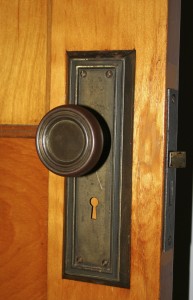
-Got a fancy doorknob for the door. For over a year, our bedroom door hasn’t had any doorknob on it all. We finally went to Northwest Architctural Salvage and found one that matches the style of our home’s architecture. It even locks with a skeleton key, which I think is pretty cool.


UPSTAIRS BATHROOM

-Installed a shelf in the cabinet. We had this cabinet that is basically just the top of the stairwell, so I vacuumed out all the cobwebs and dust in there and put in a big shelf so that we have room to store a hundred rolls of toilet paper or whatever else we want stored away.

BASEMENT COMMONS AREA

-Painted the wall next to the dryer.

-Installed shelf above dryer.

-Replaced leaky tubing to dryer’s gas line.

DOWNSTAIRS BATHROOM

-Nothing. I’m happy to say that, like Owen’s room, this room is just the way we want it.

DOWNSTAIRS SPARE ROOM

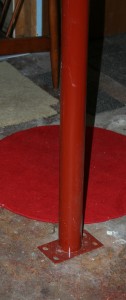
-Installed beam to jack-up ceiling. The previous owner had this amazing idea to remove the load bearing wall. And by “amazing,” I mean ridiculously stupid. So we put in a new beam. Now the kitchen floor directly above this spot isn’t caving in anymore, and we can sleep soundly knowing we won’t crash through the floor during the middle of the night. It’s a good feeling.

Here’s the lowest portion of the beam. I admit it’s not very pretty, but the whole room itself is kind of an eyesore. There are attractive coverings to buy for these beams. I’ll probably get one someday if we ever try to pretty up this room.

-Removed remainder of center wall. This provided me with lots of spare 2x4s!

YARD

-Moved retaining wall to wrap around gazebo.

Okay, so this one is kind of hard to explain, but here you can see two retaining walls coming out from the gazebo (top left). They curved through the yard and then wrapped around the workshop. Way too much yard lost to this bit of half-assed landscaping. So I altered the bricks to look like this…

…So now the bricks just wrap around the gazebo. We raised the wall up a level, too (so now it’s four bricks high instead of three). This helped to hide the ugly underside of the gazebo’s decking. It also gave me a place to pile in some of my extra soil. We put our extra hastas inside this planter, too.

-Installed rain barrel and moved gutters to align with barrel. I already bragged about this accomplishment IN THIS BLOG POST, so go there to find out more.

-Spray painted the mailslot. Yeah, I didn’t like the rusted-gold look. Now it’s spiffy and clean and white.

GARAGE

-Installed shelf near rafters

-Moved existing shelving and workbench to far corner. Yeah, I don’t know why I didn’t think of this right away, but Jennifer had the brilliant idea that we should put this stuff as far into the back of the garage as possible, so that it doesn’t interfere with our doors when we get in and out of the cars. Good idea.

-Installed hooks to hang bicycles.

-Installed gutter over workshop door. This four-foot long gutter is supposed to help prevent rain from washing off the roof and right onto the threshold of the workshop and, more importantly, prevent icicles from forming there in the winter, where they might fall onto my renter. It’s already worked for the former, time will tell if it helps with the latter.

Yep, here’s proof. There’s now a gutter above this door.

-Insulated and closed off back side of workshop. There was a missing piece on the outside of the back of the workshop. I insulated it and then installed a wood covering; this has helped prevent rainwater from washing into the workshop.

So, as you can see, a lot more went on outside the house this time, probably because these past six months have included the warmer spring and summer months. Now we’ll turn our attention back to the inside as autumn and winter descend upon us. I, for one, hope that the next update (to take place in mid-March of 2014) includes the wondrous proclamation that my daughter’s room is completed. Let’s hope!

Forgetting the Presidents

It stands to reason that if you’re going to write a book about, say, the periodic table, you should either have that table memorized front and back, or you should keep one handy as you write. That way, you won’t write something stupid like “Hydrogen has two protons.” Now, don’t get me wrong, I realize most people probably don’t know that, and that’s okay. But if you’re writing a book about the elements, on the other hand, getting that wrong is pretty inexcusable.

In like manner, if you’re writing a book about the presidents, keep a list of them handy. Just a nice, simple list that details a few of the basics like…what year(s) did this man serve as president, who were their VPs, what political party did they belong to, did they serve one or two terms (or something else), did they die in office or retire…just a few things like that.

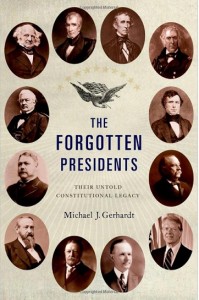
I just finished reading the book The Forgotten Presidents: Their Untold Constitutional Legacy. In it, author Michael Gerhardt details 13 presidents who fit the general descriptor of “forgotten” and explains why they should be more memorable. He restricts himself to just their interpretations of the Constitution, which is too bad, as he misses so much else to discuss. Regardless, part of the fun is Gerhardt’s rationale for which presidents he chose. After reading his book, I agree with his choices, and I’m not going to go into his reasonings here, but suffice it to say, it’s very interesting why, for example, he leaves out James Garfield (who was president for only 6 months), and Warren Harding, yet includes Calvin Coolidge (who served a term and a half) and Jimmy Carter, who is not only one of our most recent presidents, but is still alive.

But…there was a problem.

The book has lots of errors about basic presidential facts. In the acknowledgments section, Gerhardt thanks his editor “for support above and beyond the call of duty” and for providing “quiet confidence.” Perhaps that confidence was a bit too quiet; had the editor truly have gone “above and beyond,” he would have caught the mistakes that I found without even trying.

Now, when books have spelling or grammatical errors, I let them slide, figuring that stuff happens. But when a book has factual errors, I think that’s just sloppy. Especially when the errors concern the topic the book is primarily discussing. Because – and here’s the real problem – if I found factual errors on some basic items, then what didn’t I catch? Can I trust the book’s facts when I don’t know if they’re right or not? I mean, surely for every fact I found to be in error, there’s gotta be at least two that I didn’t catch, right? After all, I’m not a professor of Constitutional law who writes books about Presidents. I’m just a history minor who happens to know a few facts about the presidents.

Henceforth, here are the errors I found without even having to double-check:

PAGE 3: Right on the first page of the text, in the second paragraph, Gerhardt says “Martin Van Buren has been eclipsed by the six men who preceeded him as president,” and the next sentence calls Van Buren “the seventh president.” Nope. Van Buren was number eight. This error is so ergregious, I shared it with my son: “It’s right there on the first page!” I said. Owen laughed, also knowing that the statement was wrong. Maybe Gerhardt should’ve asked Owen to be his editor.

PAGE 34: Here, Gerhardt says that, besides Jefferson, there were “eight other presidents who preceded” William Harrison. Nope. Besides Jefferson, there were seven other presidents prior to Harrison.

PAGE 38: Gerhardt claims there were “five nineteenth-century vice presidents who became president because of the incumbent’s death.” Wrong. There were only four: John Tyler, Millard Fillmore, Andrew Johnson, and Chester Arthur. They became presidents upon the deaths of William Harrison, Zachary Taylor, Abraham Lincoln, and James Garfield in 1841, 1850, 1865, and 1881, respectively.

PAGE 104: In the first paragraph on this page, Gerhardt claims that President Pierce took cabinet member Jefferson Davis on a trip to New York in 1843. The only problem is…there was no President Pierce in 1843. John Tyler was president that year. Pierce wasn’t president at any time in the 1840s, in fact.

PAGE 127: In paragraph two, Gerhardt states that Grover Cleveland is “among the ten presidents who served for more than a term.” Um…let’s just count right now: Washington, Jefferson, Madison, Monroe, Jackson, Lincoln, Grant, Cleveland, McKinley, Teddy Roosevelt, Wilson, Coolidge, Franklin Roosevelt, Truman, Eisenhower, Johnson, Nixon, Reagan, Clinton, Bush-43, Obama. Yeah…that’s more than ten. And if we want to get really picky, Cleveland is not one of the presidents who served more than one term – he was a president twice (#22 and 24), and each time it was just a term. So it would be better to say he is among the men, or persons, who served more than a term.

PAGE 141: It stands to reason that if you’re wrong about how many men served as presdient for longer than a term, you’re also gonna be wrong about how many served for a term or less. The funny thing is, though, that since 43 men served as president, you would think that Gerhardt would here claim that 33 served for a term or less (since he said 10 served for more than a term, and 43-10=33). But no. In the first paragraph on this page, he says Benjamin Harrison “was one of fifteen men who served for one term or less.” Again, let’s count: John Adams, John Quincy Adams, Van Buren, William Harrison, Tyler, Polk, Taylor, Fillmore, Pierce, Buchanan, Andrew Johnson, Hayes, Garfield, Arthur, Benjamin Harrison, Taft, Harding, Hoover, Kennedy, Ford, Carter, Bush-41. Yeah…that’s more than 15.

PAGE 155: In the second sentence on this page, Gerhardt claims that, besides Cleveland, “sixteen other presidents” have served more than a single term. See my comments, above, for page 127. Again, he’s wrong. There haven’t been 17, and there haven’t been ten. There’s been 21.

PAGE 167: This one confused me. Here’s the sentence in question: “Hill and Cleveland had long been political foes: Hill had led the anti-Cleveland factions within New York, and as governor of New York, he had made sure that Cleveland lost New York in his 1884 reelection bid.”

…So, I’m not sure what’s going here. Who is governor of New York? Hill or Cleveland? It’s not clear. Both men served as governor; Cleveland was governor in 1884. Was Cleveland running for reelection as governor in 1884? I don’t know. But I do know that he was running for president that year. But he was only running for election – not reelection. And he carried New York in the electoral college, so Hill certainly hadn’t “made sure” Cleveland “lost New York.”

PAGE 171: So here’s a mistake I wasn’t aware of immediately, but only upon checking the endnotes (which, frustratingly, begin renumbering for each chapter). In paragraph two, it states that William Taft was “one of only six presidents handpicked by their predecessors.” Huh. That’s interesting. I wonder who those six were? So, I checked the endnote, where it reads: “The other four presidents are Madison, Monroe, Van Buren, and George H. W. Bush.” Again, the editor is asleep at the wheel here.

PAGE 191: Paragraph three claims that “Coolidge served longer” than the other six Republican presidents from McKinley through Hoover. No, he did not. Coolidge served as president from 1923-1929, for just over 5 and a half years. Teddy Roosevelt, meanwhile, served for 7 and a half years – considerably longer than Coolidge. And, yes, Roosevelt was a Republican president between McKinley and Hoover.

PAGE 214: Here, the book cites a speech President Coolidge delivered in August 1924, and says “for a lame duck, the shift in his tone and position were striking.” See my comment above – Coolidge was not a lame duck president at the time of this speech; he was not a lame duck until more than four years later, beginning in late 1928 (after Hoover won the election).

…And that’s all I caught.

As a note to Gerhardt, if you’re reading this: I greatly enjoyed your book and I thank you for writing it. Please be sure to get a better editor next time, though. I hereby offer to spot-check your next book on the Presidents, free of charge, if you’d like. Let me know. Oh, and here’s a useful, accurate list of our Presidents.